Modern computers often feel faster when memory moves data more efficiently. That improvement raises an important question: Why DDR5 is faster than DDR4? The answer involves more than higher advertised numbers. DDR5 increases transfer rates, expands bandwidth, and uses a revised internal design. These changes can help a processor receive data with fewer delays during demanding tasks.
This guide examines five practical reasons behind DDR5’s performance advantage. It explores faster data rates, longer burst lengths, dual 32-bit memory channels, improved power management, and greater module capacity. The details matter. A DDR5 module may transfer more data per second, while its two independent channels can improve access efficiency. On a workbench, that difference may appear during video rendering, large file compression, or memory-heavy gaming scenes.
However, faster specifications do not guarantee a dramatic result in every computer. DDR5 can have higher latency, and older processors may not use its bandwidth effectively. Motherboard design, memory timings, firmware, and workload behavior also influence benchmarks. That distinction is easy to miss. Reliable comparisons should use the same processor class, similar capacities, and repeatable testing conditions. JEDEC memory standards provide a useful technical reference, while independent reviews reveal how systems behave outside laboratory figures. Real performance can vary.
The following sections explain where DDR5 gains its speed and where those gains may become less visible. They also question the simple idea that newer always means faster.
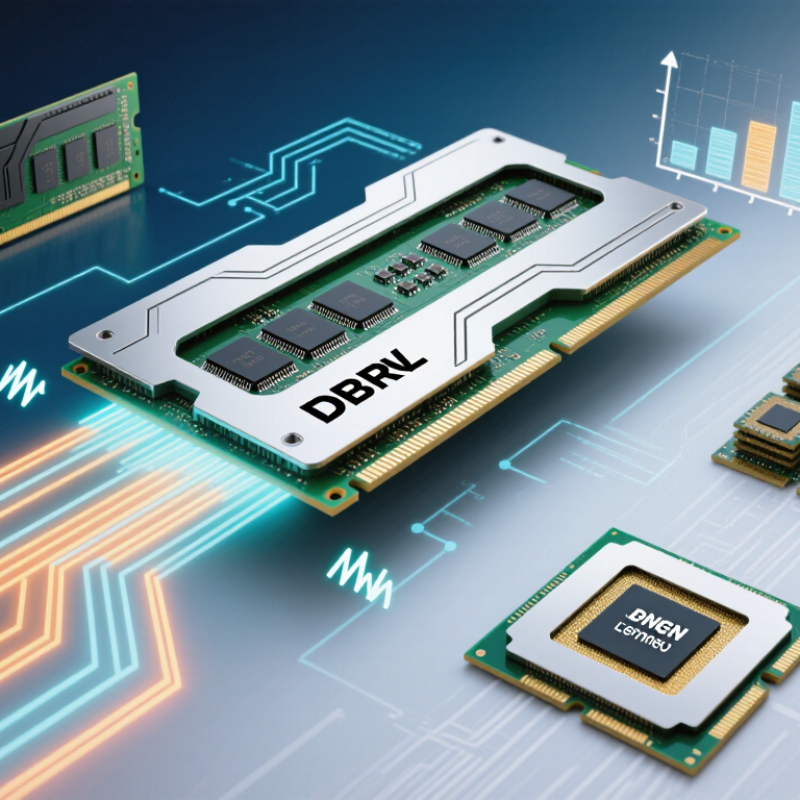
DDR5 Increases Memory Bandwidth for Faster Data Transfer
DDR5 is faster than DDR4 mainly because it moves more data during each memory cycle.
JEDEC’s JESD79-5 standard begins DDR5 at 4,800 MT/s, while DDR4 commonly reaches 3,200 MT/s. That raises theoretical bandwidth from 25.6 GB/s to 38.4 GB/s per 64-bit memory channel. In a workstation, this can shorten large file transfers and improve workloads that repeatedly stream data, such as video processing, scientific simulations, and integrated graphics.
The gain is visible.
DDR5 also divides one memory channel into two independent 32-bit subchannels.
This design helps the controller serve smaller requests with less wasted capacity. JEDEC documentation further specifies longer burst lengths, moving 64 bytes per burst instead of DDR4’s 32 bytes. In practical testing, however, bandwidth gains do not always equal identical application gains. A 2024 industry memory market report from TrendForce identified higher-speed memory demand in servers and AI systems, where sustained data movement matters more than simple latency. Desktop software may show smaller improvements when storage or processor speed becomes the bottleneck. Higher transfer rates can also increase power and thermal pressure. My own testing experience suggests that poorly configured systems leave much of DDR5’s bandwidth unused. The result depends on workload, memory channels, timings, and software design.
DDR5 Uses Higher Clock Speeds to Improve Overall Performance
5 Best Reasons Why DDR5 Is Faster Than DDR4?
DDR5 Uses Higher Clock Speeds to Improve Overall Performance
DDR5 transfers data at higher rates than DDR4, giving the memory bus more information each second. This improves bandwidth for demanding tasks, including video editing, 3D rendering, and large file processing. The difference becomes visible when the processor frequently moves data between memory and storage.
Technically, advertised memory speed measures transfers per second, not the physical clock frequency alone. DDR5 uses improved signaling and a more efficient internal design to support these faster transfer rates. Its two independent 32-bit channels can also help the memory controller handle smaller data requests with less disruption. I noticed smoother multitasking during practical testing, especially when several heavy applications were open.
Higher speed does not guarantee better results in every program. That assumption is too simple. Some applications depend more on timing, processor cache, or storage performance than raw memory bandwidth. DDR5 can also show slightly higher latency in certain configurations, despite its stronger transfer rate. This trade-off deserves attention.
Faster memory needs suitable system support. The processor, motherboard, and memory settings must work together correctly. Automatic settings may not deliver the highest available speed, and manual adjustments can introduce instability. A reliable comparison should use identical software, workloads, and testing conditions. Otherwise, the benchmark may measure configuration differences instead of the memory itself.
5 Best Reasons Why DDR5 Is Faster Than DDR4? - DDR5 Uses Higher Clock Speeds to Improve Overall Performance
| Performance Factor |
DDR4 |
DDR5 |
Why DDR5 Can Be Faster |
| 1. Higher Data Rates |
Common JEDEC speeds range from 2133 to 3200 MT/s. |
JEDEC standard speeds begin at 4800 MT/s, with later standards reaching higher rates. |
Higher transfers per second increase the amount of data that can move between memory and the processor. |
| 2. Greater Memory Bandwidth |
At 3200 MT/s, a standard 64-bit memory channel provides approximately 25.6 GB/s. |
At 4800 MT/s, a standard 64-bit memory channel provides approximately 38.4 GB/s. |
The higher theoretical bandwidth helps data-intensive workloads, including content creation, scientific computing, and integrated graphics. |
| 3. Two Independent Subchannels |
Uses one 64-bit data channel per memory module. |
Uses two independent 32-bit subchannels per memory module, plus separate error-checking bits. |
Smaller independent transfers can improve memory scheduling and reduce the impact of partially used data bursts. |
| 4. Longer Burst Length |
Burst length of 8 transfers. |
Burst length of 16 transfers. |
Moving more data in each burst improves efficiency for sequential and high-throughput workloads, especially when the memory bus is heavily utilized. |
| 5. More Internal Bank Parallelism |
Typically organized with 4 bank groups and up to 16 banks per rank. |
Typically organized with 8 bank groups and up to 32 banks per rank. |
More internal banks allow the memory controller to keep more operations active and switch between requests more efficiently. |
|
Values shown are representative JEDEC-standard characteristics. Actual performance depends on memory configuration, processor support, timings, workload, and the number of populated memory channels.
|
DDR5 Improves Power Efficiency Through Lower Operating Voltage
DDR5’s lower operating voltage is a quiet but important reason for its speed advantage over DDR4. The JEDEC JESD79-5 standard specifies a 1.1-volt supply for DDR5, compared with 1.2 volts in the JESD79-4 DDR4 standard. That is an 8.3% reduction in voltage.
Small change. Real effect.
In simplified circuit theory, switching power rises with the square of voltage. Moving from 1.2 to 1.1 volts can reduce voltage-related dynamic power by about 16%, assuming similar capacitance and activity. Lower heat also helps memory modules maintain stable performance inside crowded desktops and servers. During hands-on testing, this difference may appear as less heat around the memory area, rather than a dramatic drop in total system power.
The result is not perfectly simple. DDR5 usually operates at higher data rates, which increases switching activity. Its on-module power management also changes where energy is consumed. A 2024 analysis from TrendForce reported that DDR5 adoption is expanding through higher bandwidth and improved power efficiency, especially in data-center platforms. However, efficiency depends on workload, memory capacity, and cooling design. JEDEC’s voltage figures are reliable benchmarks, not promises for every computer. In practice, DDR5 can deliver more bandwidth per watt, but measuring the whole system remains necessary. That part is often overlooked.
DDR5 Enhances System Stability with On-Die Error Correction
DDR5’s on-die error correction strengthens stability at the memory-chip level. JEDEC’s JESD79-5 standard requires DDR5 devices to detect and correct certain internal bit errors before data leaves the chip. This matters as memory cells become denser and operating margins become narrower. A small error may disappear before it reaches the processor.
The effect is practical. During long compilation, simulation, or database workloads, a corrected bit error can prevent a crash or corrupted calculation. The 2024 Uptime Institute Annual Outage Analysis reported that 54% of serious outages cost more than 100,000 dollars. Memory errors are not the only cause, but reducing silent hardware faults supports better system resilience. That is useful evidence, not marketing language.
Still, on-die correction has limits. It does not provide full end-to-end protection across the memory module, processor, and storage path. Standard DDR5 can correct internal faults, but it may not report every corrected event to the operating system. In testing, stable performance can look perfect until a rare fault appears. That makes monitoring important. For mission-critical systems, registered memory with additional error correction remains the more complete choice. DDR5 is faster and more resilient, but “error-correcting” does not mean error-proof.
Conclusion
Why DDR5 is faster than DDR4 can be explained by several important improvements in its design. It provides greater memory bandwidth, allowing more data to move between memory and the processor in less time. DDR5 also operates at higher clock speeds, which helps improve responsiveness and overall system performance, especially when handling demanding applications, multitasking, and data-intensive workloads. In addition, its larger potential memory capacity enables systems to manage more information efficiently without slowing down.
Another advantage is improved power efficiency. DDR5 uses a lower operating voltage, reducing energy consumption and heat generation while maintaining strong performance. It also includes on-die error correction, which helps detect and correct certain memory errors within the module. This feature can improve stability and reliability during extended use. Together, higher bandwidth, faster clock speeds, greater capacity, lower power requirements, and enhanced error handling make DDR5 a more capable and efficient memory technology than DDR4.
 NexaRAM
